The Hand and the Model
Choosing has its own slope: it drifts back toward the middle as surely as the model does. What the hand taught me, where deliberation has moved, and what protects the eye from itself.
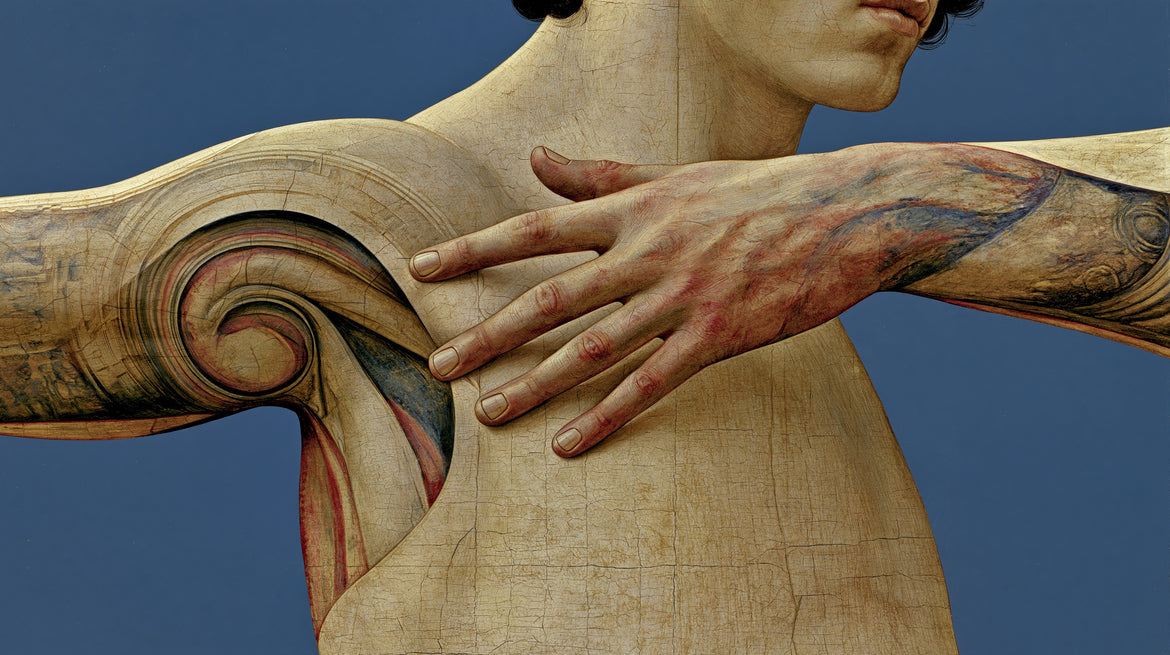
When an image passes through a generative model, the hand no longer lays down every stroke. The usual conclusion is that the craft comes down to choosing, and that choice is then defended as a gesture in its own right. I think the defense is right, but incomplete, because choosing has its own slope: it drifts back toward the middle as surely as the model does. This text describes the craft as I practice it today, what the hand taught me, where deliberation has moved, and what protects the eye from itself.
I still draw, I paint, I work on a tablet. But these gestures no longer show on their own. What I show passes through a generative model, working from a map my hand drew before it and outside it, and that I sometimes take up again by hand along the way. The question of craft remains, one I am rarely asked to my face and that people ask themselves all the same: what is left of making when the hand no longer lays down every stroke?
What the model changes fits in a few words. It hands over sophisticated forms without the long road that was once the only way to reach them. I have walked that road. The question is what it is still good for.
The hand trained me first. Oil, acrylic, watercolor, drawing and screen printing each have their rules, but they all belong to the same regime. One color unsettles another, the paint resists, the gesture hesitates, and the pentimento keeps the memory of an abandoned choice. It is in this regime that the knowledge of making settles. You do not only learn gestures there; you learn to see the balance that sets in or slips away, the deviation that brings a form to life, the almost-right that ruins it. This learning does not leave when you put the brush down. It stays in the eye, and it is the eye that goes to work afterward in front of a grid of generated images.
The gesture has changed; the work of recognition has not. Skimmed lightly, a grid yields nothing. Gauged by an eye that learned, by hand, to feel where an image holds and where it gives way, it can yield one that holds.
This work is often described as choosing. That is partly true, and it is no reproach: art has known for a century that a choice can make a work. What qualifies an image is not that the hand laid down every point, but that a stretch of deliberation was spent somewhere in the chain that produced it. In painting, that time lives in the gesture, each stroke committing the next. With a model, it is distributed differently: upstream, in the map I build by hand and submit to it; downstream, in the sorting. It does not disappear. It moves.
Still, that time has to meet resistance. A chess player deliberates at length over a move, and the move is not a work. What is missing is a material that resists. In painting, that is the medium. With a model, it is the model itself, which has its slope, a center it returns to as soon as you stop constraining it. Its resistance is not that of paint. Paint opposes the gesture, and intention sharpens on contact with it. The model proposes faster than you can search, and in front of its first images you are quick to give up what you were looking for and take up what it offers. It does not oppose intention; it draws it in.
Not every deviation is a defeat, and some works are born of an image no one expected. But each time, you have to know whether it deepens what you were looking for or replaces it.
That is the ordinary defense of choosing: a displaced deliberation meeting a stubborn material. For a long time I held it to be sufficient. It rests on an assumption rarely examined: that the eye doing the sorting does not lean. The slope would sit in the machine, and judgment, downstream, would stand straight.
But the eye leans too.
This has been measured in two ways, which match what the studio teaches anyone willing to see it.
First, faced with a set of images, people more readily choose the one that sits in the middle of the others by its style: the most average, the one that best sums up the set. And the effect grows as the set becomes more varied. The wider the range, the more the choice returns to the center. Those choosing do not notice. Asked why, they give the same reasons whether they took the middle or an edge: they believe they are following their taste.
Second, a trained eye does not look the same way depending on what trained it. Trained by rules, it looks less at whatever does not help to classify. Trained by examples, it keeps a wide gaze, and even notices variations better. But in both cases, faced with a form it has never seen, it describes that form by what it lacks against what it knows, rather than by what it shows. And the discoveries no one was looking for come more often from those who were not trained.
Consider what this does to sorting. A grid of generated images is precisely a highly varied set, since the model widens the range. It is even what the model does best. The pull toward the middle thus finds its most favorable condition exactly where we thought we had escaped it: the model widens the range, and the eye narrows it again without knowing. As for training, it offers no protection. Trained by the hand, that is, by examples more than by rules, my eye may keep a wide gaze. It does not escape the other slope for all that. In front of an image that resembles nothing I know, I risk judging it by what it lacks, measured against what I know of a successful image, rather than by what it brings.
In The Consensus Machine I described two forces that pull images toward the center: the probable, which the model learned from its data, and the preferred, which it was taught afterward when it was tuned to our tastes. I wrote that whoever evaluates has learned to see before evaluating, and rewards what they recognize. I was not thinking of myself first. I should have been. There is a third force, and it does not sit in the machine: it is the center of my own gaze.
What Holds described two thresholds, one in perception, the other in the self, and said that the artist crosses them in producing. It did not say where. I meet them in two places. Upstream, when the hand draws the map and moves toward what it does not yet know: that is where the work starts to cost. And at the sorting, where I least expected them. The first threshold sits there in the eye, which prefers what it recognizes and brings the unknown back to the known before it has even looked. The second is more intimate. To keep an image my trained eye cannot validate is to cede something of what I believe I know how to see, that is, of what grounds my craft in my own eyes. That is where the guardian waits for me: before the idea I have of my eye, far more than before the strange image. And the finest trap is to keep the slightly strange image, the one whose strangeness can still be brought back to the known, believing I have taken a risk. It is the shape the ego's old ruse takes in the craft: the illusion of having crossed without ceding anything.
The trained eye is therefore my best tool, and the most faithful of my guardians. The two cannot be separated. The same training lets me recognize an image that holds and pushes me to recognize too quickly.
If the eye leans without knowing, vigilance is not enough. A lean you do not feel is not corrected by thinking about it. You have to act on what comes before the eye rather than on the eye itself.
This is where the hand of before takes on a function I had not seen. Sorting chooses among what is proposed; the map changes what is proposed. The drawings and paintings I submit to the model were made before it and outside it, sometimes years earlier, by a hand that knew nothing of the grid to come. The model skips the long road that led to forms; the map puts that road back into the chain. It commits the work before the eye of the day has had time to drift back to the middle, and before the first image to come along has had time to turn me away from what I was looking for. What yesterday's hand decided, today's eye can no longer soften. It only sorts within a range already displaced.
So there are two slopes, the model's outside and mine inside, and the map works against both at once. It forces the model off its center. It obliges me to choose among images my taste would not have asked for.
At the sorting itself, I have no method. I keep what catches my eye: what holds and offers something singular, formal, graphic or otherwise. The image in the middle often holds; it rarely offers anything singular. This double criterion does not keep me safe, but it gives the eye a reason not to stop at the center.
It matters all the more because sorting is not a single choice. The proposals advance along an axis I am trying to explore, and each image I keep becomes the starting point for the next ones. But left to itself, this exploration returns to the center: from one stage to the next, the model takes back a little of the deviation that had been wrested from it. So you have to push, and the hand comes back into the course of the work. At any moment, I can reintroduce an outside element, a drawing, a painting, or an earlier render that was itself singular, to bend the slope again. I can also take an image back to the tablet, to inscribe a tendency the model refuses to take. What I put back into the circuit this way is what departed from the average, the reverse of the loop that impoverishes models.
It resembles what children do on the beach, when they dig channels in the sand to guide the sea. You do not command the water. You cut it a bed, and you have to dig it out again and again, because the water erases whatever you stop tending.
The series extends this work. Some polarities cannot be said in a single frame: the single image freezes one face of them, and the others fall out of view. The series is then the form in which a polarity unfolds, the movement of the eye between frames that together approach what none would say alone. The hand learned this through wear, returning to the same motif for years, until it understood that the iteration itself was doing work. The model makes that rhythm workable in a few weeks.
The series has a quieter virtue too. An image kept on its own is judged against the average of the grid it came from, and the average often wins. In a series, you ask something else of it: what it does among the others. A series keeps the edges. It obliges you to hold together images that do not fall in the same place, and it leaves the viewer the gap between them. What I asked of machines in The Consensus Machine, to keep the spread rather than reduce it to a point, the series does at my scale.
None of this work shows as such. An image shows neither the hand that prepared it nor the eye that kept it. It holds or it does not, and it must hold without anyone telling how it was made. But what makes it hold, when it holds, is a trained eye that has spent deliberation against a material that resists, and that had, in the end, to distrust itself. That is why the hand still matters, even when it no longer lays down every stroke. It has not disappeared. It has moved to another post.
References
The text does not cite in its body; here is the apparatus, grouped by what it supports.
- Choice as an artistic gesture. The readymade, from Marcel Duchamp onward (1913-1917).
- Forms without the road. Amit Raphael Zoran, "More than we can make: generative AI, artistic forms, and artistic becoming", AI & Society (2026, open access). Generative AI makes it possible to obtain forms whose sophistication once required their author's training, without that training.
- The deviation that deepens and the deviation that replaces. João Pedro Oliveira, "Beyond automation: Artificial intelligence and embodied craft in artistic practice", Organised Sound (2026, open access, CC BY). Craft knowledge as tacit knowledge rather than a stock of rules; the risk of letting a seductive image replace the intention instead of deepening it; judging a material by what it does in the work.
- The model draws intention in. Michelle Dutoit and Baptiste Caramiaux, "Exploring Normativity in Stable Diffusion: Insights for XAI in the Arts", arXiv:2608.26980 (2026, workshop paper, 14 practitioners). Faced with the system's norms, illustrators adjust their intention to what it can do, or abandon it to iterate on what it produces first.
- Choice returns to the middle. Huiyang Chen and Keqing Jiao, "Central Tendency Bias in Human Selection of AI-Generated Design Variations", arXiv:2607.09018 (2026, preprint accepted at HAXD 2026). Laboratory study, 50 participants, posters built by hand along a style continuum: the more varied the set, the more often the central image is chosen (56% versus 34% of preference choices), while the stated reasons do not change. The authors conclude that user vigilance is not enough and propose, among other things, presenting images in successive subsets rather than all at once.
- What training makes you see, and stop seeing. Shawn Ogunseye, Jeffrey Parsons, Roman Lukyanenko and Yoones Sekhavat, "The training–discovery paradox: Evidence from citizen science", PLOS ONE 21(10), e0361148 (2026). Citizen science archives (206 credited discoveries) and an eye-tracking experiment (60 participants): rule-based training reduces attention to features that do not help to classify; example-based training preserves it; both push people to describe the new by what it lacks against the learned category.
- The exploration returns to the center when you do not push. Vibhas Kumar Vats, David J. Crandall and Samuel Goree, "A Markovian View of Iterative-Feedback Loops in Image Generative Models: Neural Resonance and Model Collapse", arXiv:2602.19033 (2026, preprint). When the outputs of a frozen model become its references again, generation after generation, the images converge toward a narrow, stable structure: details erode, and on varied images meaning is lost within a few rounds. The authors start from Alvin Lucier's I Am Sitting in a Room (1969), where all that remains at the end is what the room can make resonate.
- Branching rather than averaging. Jimmy Secretan, Nicholas Beato, David B. D'Ambrosio, Adelein Rodriguez, Adam Campbell, Jeremiah T. Folsom-Kovarik and Kenneth O. Stanley, "Picbreeder: A Case Study in Collaborative Evolutionary Exploration of Design Space", Evolutionary Computation 19(3), 2011, pp. 373-403. Each image kept becomes the starting point of a new branch. Systems in which several people voted on a single lineage ended in mediocre images nobody really liked. And most of the highest-rated images do not descend from highly rated ones: the value of a step cannot be seen at the moment it is taken.
- What the exploration owes to the taste of whoever chooses. Sam Earle, Kai Arulkumaran, Andrew Dai, Akarsh Kumar, Julian Togelius and Sebastian Risi, "In Search of the Ingredients of Open-Endedness: Replicating Picbreeder with Large Vision-Language Models", arXiv:2605.23908 (2026, preprint). The Picbreeder setup replayed with vision-language models in place of humans. The machines lock themselves into attractor forms and always start again from the same images; humans make larger leaps and keep sharper images.
- Internal links: Corrupt (May 2026), The Consensus Machine (June 2026), What Holds (June 2026).
 Next writing
8 August 2026
10 min
The Local Form