
The Local Form
I work with the body inside generative systems because it is at once remarkably stable there and surprisingly fragile. By pushing that stability toward its limits, a question begins to emerge: what if what we call a human being is not a primary form, but the local resolution of a process that exceeds it without necessarily standing above it?
A generative model contains no body.
It has learned relations between forms, textures, positions, words and fragments of images. In diffusion models, an image gradually emerges through a process of reconstruction. In latent diffusion models, part of this process takes place within a compressed representation learned from images. Nothing there resembles a complete little body waiting to be extracted. The figure appears when a set of relations resolves into a form coherent enough for us to recognize it.
It is precisely because this resolution works so well that the body interests me.
Generative systems have absorbed an immense quantity of human representation. They know our proportions, our postures, our faces, the ways we photograph and draw ourselves. When allowed to return toward their most probable solutions, the body tends to close again. It recovers a skin, an anatomy, an identity. It becomes someone.
My work begins when that resolution is disturbed.
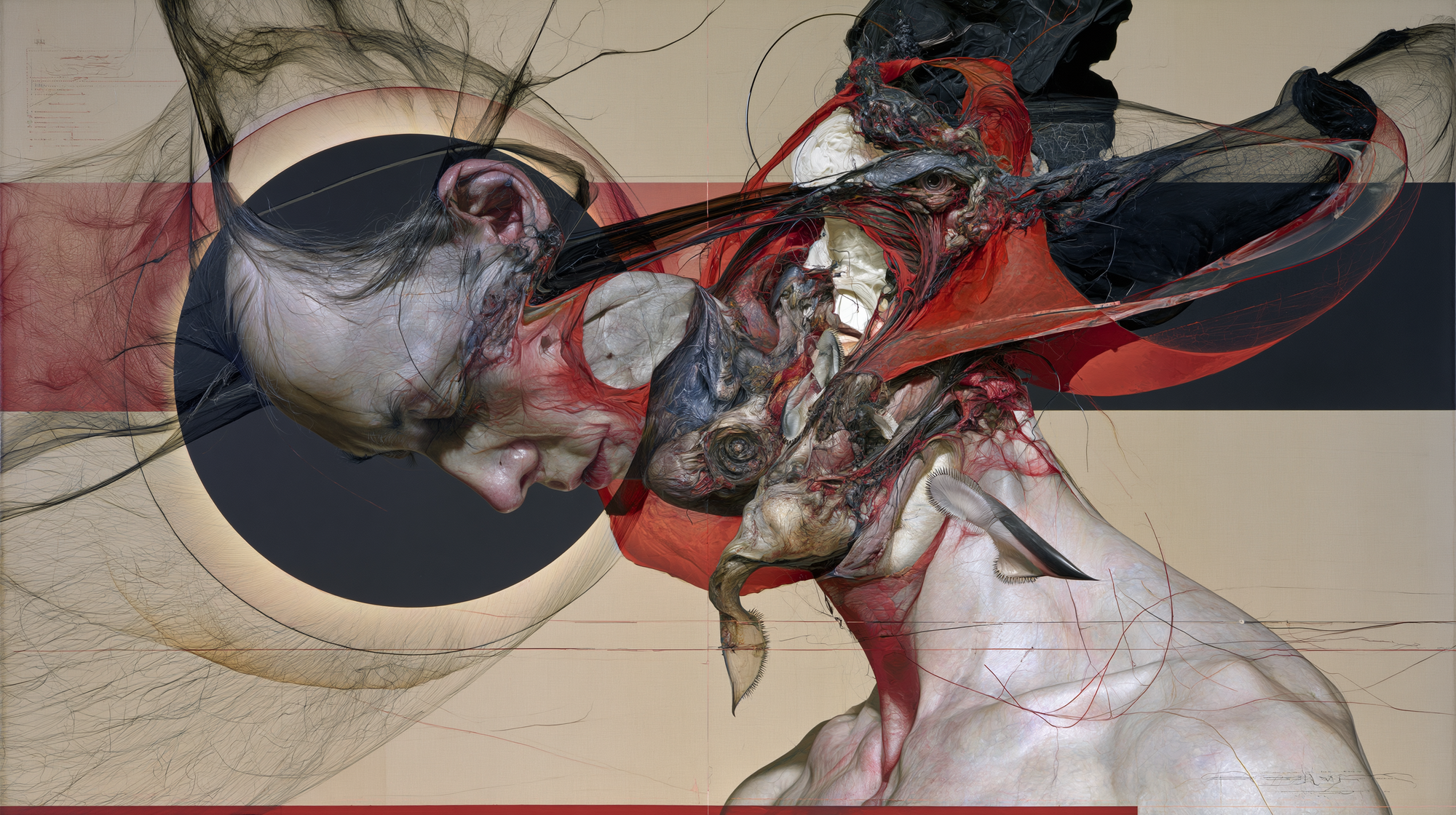
I introduce drawings and bodily studies made before the system and outside it. I displace, repeat, corrupt, reintroduce. As the model negotiates with this foreign grammar, something happens to the body. It does not disappear. Instead, it ceases to remain entirely separate from what surrounds it.
A curve can still belong to a shoulder while already becoming part of an architecture. A cavity can appear anatomical without corresponding to any organ. Matter can cross the skin without allowing us to decide whether it comes from inside or outside. Some structures seem to sustain the body at the very moment they undo it.
I do not understand these as the organs of a secret anatomy.
Such a reading would assume that behind visible anatomy lies another anatomy, deeper and therefore more true. It would restore exactly the hierarchy these images have begun to make uncertain.
Perhaps the problem needs to be posed differently.
We tend to mistake stability for substance.
Because a face maintains its boundaries for long enough, we say: there is a person. Because a body remains recognizable through its transformations, we assume that some fundamental unity precedes those transformations and undergoes them.
But the proposition can be reversed.
Unity may not be what comes before the process. It may be what the process produces when, for a time, it manages to hold.
This intuition has a precise philosophical precedent in Gilbert Simondon. For Simondon, one should begin not with the already constituted individual but with individuation, the process through which something becomes an individual. The individuated being does not exhaust the preindividual field from which it emerges. It remains a partial resolution, still carrying potentials that its formation has not consumed.
The proximity to the generative process is striking, but it must remain an analogy.
An image model proves nothing about the ontology of the world. It simply gives us a situation in which we can observe, very concretely, a form appearing without having previously existed as a constituted object.
The model does not possess a body.
It possesses learned conditions from which a body can appear.
What if that distinction matters beyond the model?
Physics itself offers a useful caution against the assumption that the most elementary level must therefore be the only truly real one.
In More Is Different, Philip Anderson argued in 1972 that knowing the laws governing elementary constituents is not enough to replace the concepts required at more complex levels of organization. New scales give rise to their own regularities and their own forms of intelligibility.
This proves no metaphysics. It does, however, weaken the simple assumption that explaining what lies below somehow makes what appears above less real.
A cell is not less real because it is made of molecules.
A body is not less real because it depends on cells.
A thought does not become fictional because it depends on a body.
Dependence alone does not establish a hierarchy of reality.
This distinction becomes important when leaving science and returning to older metaphysical intuitions.
As above, so below.
The phrase has become almost inseparable from the idea of correspondence between different levels of reality. Yet we usually read it in only one direction. What is below resembles what is above because it is assumed to be its denser, material, imperfect expression. Behind the body there would be a subtler form. Behind the world, a model. Behind matter, spirit.
The language of verticality then quietly becomes a language of value.
Higher means subtler.
And subtler gradually comes to mean more real.
But correspondence itself does not require this conclusion.
If what is below is like what is above, then what is above is also like what is below.
The formula can close back upon itself.
The subtle may not be the original of which matter is a copy. Dense and subtle could instead be different configurations of a principle that is itself neither dense nor subtle, neither higher nor lower.
Neither above nor below would come first.
They would be local.
Certain currents of Indian philosophy make this hypothesis particularly vivid.
In Sri Aurobindo, the evolution of consciousness is not understood as the inexplicable appearance of something entirely absent from matter. It presupposes an earlier involution: what progressively appears through evolution was already involved, in another mode, within Nature. Matter thus bears a consciousness that does not yet manifest as consciousness. Evolution becomes the unfolding of what had been involuted.
The traditional image of Father and Mother can then be displaced. Nature is no longer simply inert matter fertilized from outside by a consciousness superior to it. It already carries what will later become manifest through it.
But a difficulty remains.
As soon as we speak of involution and ascent, matter and consciousness, language easily restores a hierarchy. We imagine a ladder at whose summit something would finally become fully real.
It is precisely this ladder that I want to leave unresolved.
Perhaps a subtler organization is not more real.
Perhaps it is simply less constrained, more integrated, capable of other relations.
And perhaps what we call matter is not an impoverished version of that organization, but one of the ways the same principle configures itself when subjected to particular constraints.
Nature would not conceal reality.
It would be one of its forms.
Our technological age has rediscovered this old metaphysical structure in a language more suited to itself: the simulation hypothesis.
The argument Nick Bostrom formulated in 2003 does not claim to prove that we live in a simulation. It constructs a trilemma concerning the possibility that advanced civilizations might produce vast numbers of ancestor simulations and the probabilistic consequences that would follow.
But the imaginary that has grown around the argument says something about us.
If our universe were simulated, we immediately imagine that somewhere there must be a base reality. An external world would contain the machines producing ours. Almost automatically, it becomes the true world, while ours is reduced to a reflection.
We have recovered above and below.
Creator and creation.
Original and copy.
Yet once again, causal dependence is not enough to establish an ontological difference.
David Chalmers makes precisely this argument when he maintains that virtual realities can be genuine realities. If we lived inside a sufficiently complete simulation, the objects we encounter would not thereby cease to exist. Their mode of constitution would be different from what we had believed, but they would remain the real objects of the world in which we live.
A machine producing a world may stand outside that world without, for that reason alone, being more real than it.
And nothing guarantees that the machine itself belongs to the final level.
Another level can always be added.
And then another.
As we continue climbing toward base reality, another possibility becomes visible: perhaps what we are seeking is less a logical necessity than a place where the regress can stop.
A ground.
An original.
Something that would no longer need to be explained by what precedes it.
But perhaps reality has no first floor.
This is where I return to the body.
Generative systems offer a reduced, artificial and observable version of this problem.
A figure appears from a set of relations that themselves possess no body. The figure then becomes coherent enough to be recognized as a person. I can intervene in that resolution, introduce another map, disrupt certain continuities and intensify certain tensions.
When the resolution becomes unstable, something of the construction becomes visible again.
Not the actual mechanisms of the model. The forms visible in my images are obviously not scientific visualizations of its internal operation.
What they make available is something else: the intuition that a unity can be produced without being primary.
This is where my recent work on the body takes place.
I am no longer interested only in deforming anatomy.
I am looking for the moment when anatomy ceases to be sufficient to explain the figure.
A face remains a face while part of it already belongs to something else. A body remains human while the structures passing through it no longer respect the separation between organic and mineral, inside and outside, the living and its environment.
The figure still holds.
But now we can see that it holds.
That difference matters.
It would be easy to turn these images into illustrations of a cosmology: superior forces penetrating matter, an invisible architecture governing bodies, a deeper reality breaking through behind our own.
I would rather not know.
An image becomes less interesting when it explains what it shows.
The structures I bring into view can be understood as forces, relations, memories, organizations, statistical residues or projections. None of these words exhausts them. Their function is not to reveal what the world really is, but to suspend for a moment the certainty with which we decide where one thing begins and another ends.
The body is particularly suited to this experiment because it is our most immediate boundary.
We instinctively say: this is me, that is not.
And yet the body holds only through what passes through it. Matter, energy, language, inheritance, environment, other bodies, representations. Remove enough of these relations and the individual we assumed to be primary becomes impossible to isolate.
This does not mean that the individual is an illusion.
It means that perhaps the individual is local.
The question is therefore no longer what lies hidden behind the human.
That formulation still assumes a surface and a world behind it.
The question becomes:
what relations must temporarily hold together for a human being to appear?
The generative system allows me to ask this question of a representation. I present it with a bodily map, it attempts to resolve that map with its own, and I work in the interval where neither fully prevails.
What returns is neither the initial drawing nor the model's habitual statistical representation.
A body appears between the two.
A local form.
I do not know whether reality works this way.
The model does not prove it.
Philosophy does not prove it either.
Metaphysical traditions have proposed their own answers, while the sciences describe other levels through other criteria and other methods. Their proximity does not allow us to confuse them.
But the image can keep one hypothesis open:
what exceeds a form may not stand above it. It may also be what the form is made of.
The old verticality then folds back upon itself.
As above, so below.
As below, so above.
Not because one copies the other, but because both might be different resolutions of the same reality under different constraints.
And under this hypothesis, the human would be neither a degraded copy of some higher form nor an isolated exception within matter.
It would be one of the local ways reality holds.
References
- Gilbert Simondon, L'Individuation à la lumière des notions de forme et d'information. The individual understood as the result of a process of individuation rather than the ontological starting point, and the concept of the preindividual.
- Sri Aurobindo, The Life Divine. The involution and evolution of consciousness in matter.
- Philip W. Anderson, “More Is Different,” Science, vol. 177, 1972, pp. 393-396. On levels of organization that require their own descriptive concepts.
- Nick Bostrom, “Are You Living in a Computer Simulation?”, The Philosophical Quarterly, vol. 53, 2003, pp. 243-255. The simulation argument and its trilemma.
- David J. Chalmers, Reality+: Virtual Worlds and the Problems of Philosophy, 2022. A defense of virtual realism, according to which a simulated reality may nevertheless constitute genuine reality.
- Jonathan Ho, Ajay Jain, Pieter Abbeel, “Denoising Diffusion Probabilistic Models,” NeurIPS, 2020; Robin Rombach et al., “High-Resolution Image Synthesis with Latent Diffusion Models,” CVPR, 2022. Technical references on diffusion models and generation in latent space.