
Why the body satisfies generative systems — and why that matters
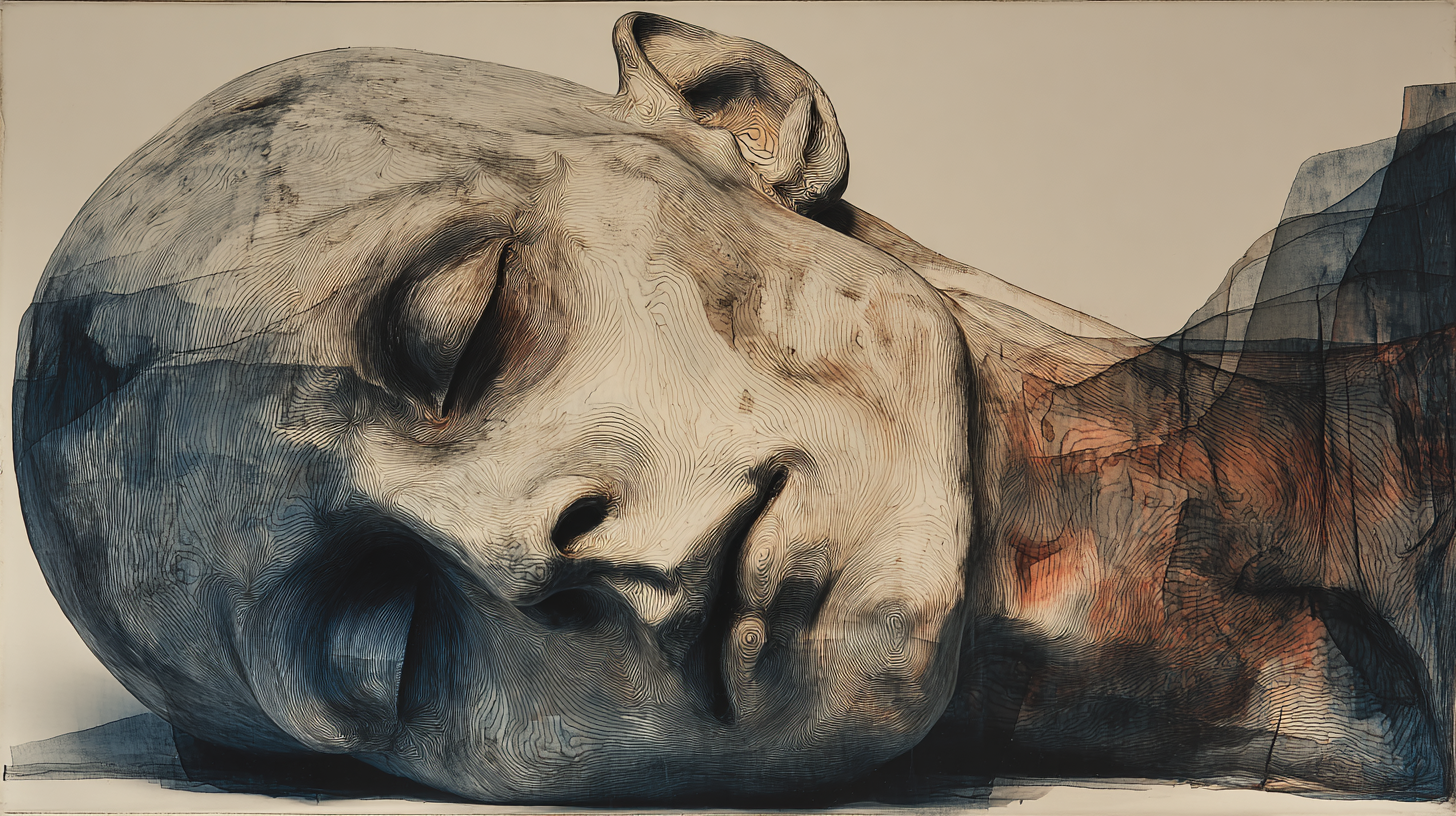
Generative systems produce bodies with ease, but often without friction. By confronting the dataset with the drawn line, the image becomes unstable again, requiring attention instead of automatic recognition.
Generative image systems are trained on what has been most seen. Billions of photographs, illustrations, advertisements, medical scans, fashion editorials, stock images — all compressed into statistical models that learn to produce what looks most probable. And what looks most probable, when it comes to the human body, is what has been most repeated.
Smooth skin. Symmetrical features. Resolved posture. Neutral lighting. The body as product shot.
This is not a flaw in the technology. It is the technology working as designed: compressing human visual culture into its most statistically efficient forms. The output is legible, functional, immediately recognizable. It triggers no friction. Perception slides over it without resistance.
The result is a body that satisfies the system — optimized, averaged, culturally validated. A body that nobody needs to look at twice.
What gets lost in this optimization is not the body itself. The body is there. What disappears is the mode of attention it once required.
A cracked fresco demands proximity. A face in a Fayum portrait holds your gaze because it refuses to resolve into type. An anatomical drawing from the sixteenth century insists on the body as structure, as weight, as material under pressure. These images work because they resist the kind of instant legibility that generative systems are built to produce.
When recognition happens automatically, looking becomes redundant. The image confirms what the viewer already expects. There is nothing left to attend to.
This is where the body becomes interesting again — not despite the generative process, but because of what it reveals about it.
If you introduce a hand-drawn figure study into a generative system — not as a prompt, but as an image-source — the system is forced to negotiate with material it has not been trained to optimize. The drawn line carries weight, hesitation, physical pressure. It does not resolve into the smooth gradients the model expects. The system responds by producing configurations that sit between its learned patterns and this foreign input: forms that are legible enough to hold together, but unstable enough to resist automatic recognition.
The body in these images is not abstract. It is still a figure, still a posture, still skin and bone. But the mode of perception has shifted. The viewer cannot rely on reflex. Attention is required — not as effort, but as the only way the image becomes available.

This matters beyond the studio. Generative systems are rapidly becoming the default infrastructure for producing visual culture. The images they circulate are not neutral — they carry embedded assumptions about what a body should look like, how it should be lit, what posture it should hold. The more these assumptions go unexamined, the narrower the visual field becomes.
Working with the body is not a nostalgic gesture. It is a way of testing where the system's defaults end and where perception can begin again. The cracks, the erosion, the displacement — these are not aesthetic effects. They are the visible evidence of a confrontation between two systems of representation: the drawn, which carries the weight of a hand, and the generated, which carries the weight of a dataset.
What appears in that confrontation is not damage. It is the image becoming active again — demanding a presence that optimized representations no longer require.
The question is not whether generative tools can produce images of bodies. They can, endlessly, effortlessly. The question is whether those images still ask anything of the person looking at them.
When they stop asking, they stop functioning as art. They become signals — efficient, disposable, interchangeable. The body deserves more than that. And so does the act of looking.