
Statement
Working from my own drawings and bodily studies, I use generative systems to erode normalized images of the human, seeking the unstable zones where recognition fails and perception becomes active again.
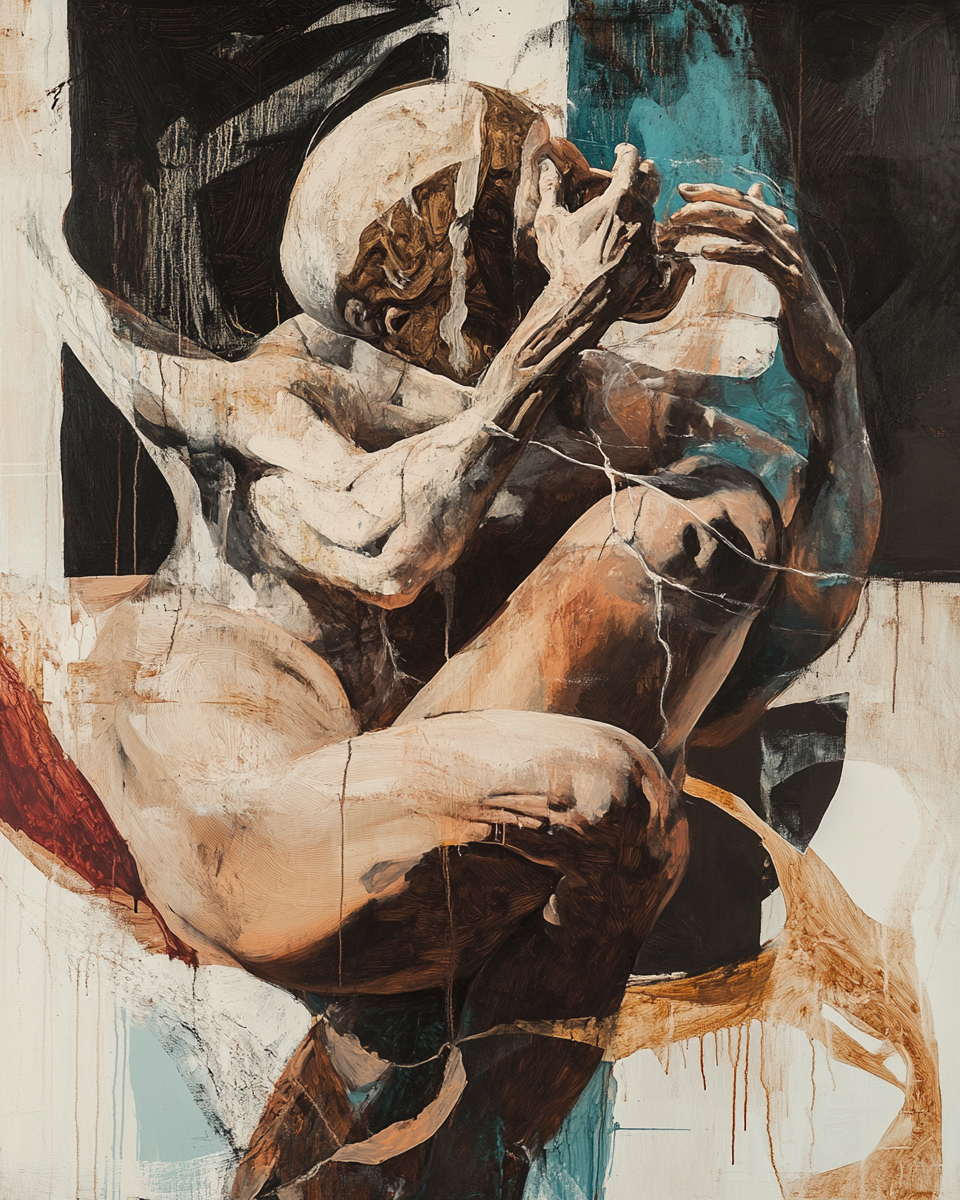
I use generative tools to work on representations of the human.
These systems do not invent images. They condense vast amounts of human-made visual culture, reinforcing dominant patterns while marginalizing others. What they produce is not neutral, but a statistical average shaped by what has been most visible, most repeated, most standardized.
Left untouched, this output tends toward sterility — not because of the machine itself, but because of the accumulation of optimized representations it carries, shaped by decades of mass imagery and visual normalization.
Generative systems tend to circulate around stabilized regions of visual space, where forms remain legible, efficient, and culturally validated. Difference exists there, but largely contained. Images function smoothly, triggering familiar responses. Perception slips easily into reflex.
My work operates within this uneven field. Starting from my own drawings and bodily studies, I intervene to displace and erode the most normalized layers. By pushing the system away from its statistical centers, I explore configurations where legibility weakens and optimization begins to fail.
The human is not absent from normalized regions. It is already there. What changes in these unstable zones is not its presence, but the mode of perception. When recognition no longer resolves itself automatically, attention is required.
In these moments, something essential may appear: not a hidden essence, but a latent human capacity to attend, imagine, and make sense without predefined responses. When the mind is no longer saturated with ready-made meanings, perception becomes active again.
I am not interested in style, nor in the spectacle of technology. What matters is this loss of footing, this suspension where images stop functioning as signals and begin to demand presence.
The role of art is not to invent novelty, but to extend what can still be seen, imagined, and thought.