
Corrupt
Corruption is not a malfunction. It is a method. On introducing a foreign grammar into generative systems, and what the output becomes under pressure.
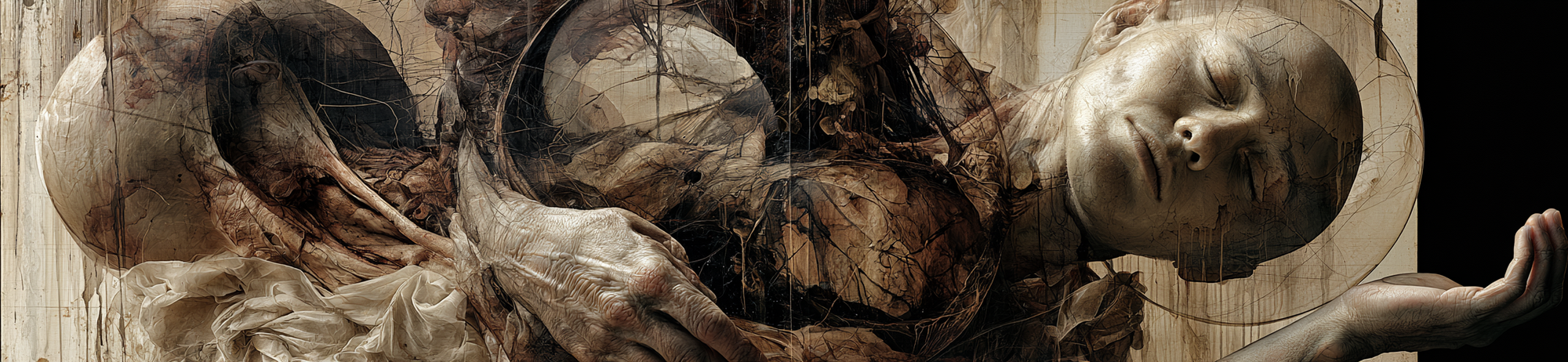
A generative model does not produce what you ask for. It produces what it has seen most often, slightly displaced in the direction you indicate. Its natural tendency is return. Toward the mean, toward the archetype, toward the most consensual representation of whatever you submit. The human body, in particular, always gravitates back to the same equilibria: normalized proportion, aestheticizing tension, the softened version.
Correcting that is not enough. Correction assumes you are adjusting something that already exists in the system. What I am trying to do is different: introduce something that is not there.
My source corpus is a body of acrylic studies of the human body, developed since 1996. A grammar built outside the data flows, before the data flows, that owes nothing to training sets except through distant and indirect lineage. The model has not seen it. It cannot recognize it for what it is. When I introduce it as a visual reference, the model resists: it produces a weakened version, or abandons the attempt and retreats toward what it knows best, toward its most established reflexes around body representation.
The model cannot fully absorb it.
► That point of resistance is what interests me.
Not what the model accepts from my grammar. What it cannot digest. What remains foreign in the output, what has not dissolved into the mean, what forces the system toward a zone it would not have reached on its own. The corrupted output is neither my archive reproduced nor the model's habitual production. It is a third state, unstable, generated by the friction between the two.
Corruption is not a malfunction.
► It is a method.
It requires treating latent space not as a reservoir of forms to draw from, but as a set of territories of representation: zones of variable density, places where collective visual habits accumulate, where archetypes and recognition reflexes settle. Some of these territories are saturated, well-guarded, resistant to drift. Others are more porous. The question is not to inhabit them but to make them interrogeable, to apply enough pressure that something gives.
What I put into the model does not change it.
► What it produces under that pressure does.