Topography
A reflection on how generative models inherit dominant visual regimes, and how drawing can become a hidden map for reaching other possible bodies within the model. Rather than using AI to reproduce the probable image, this text explores how older gestures, paintings and bodily studies can guide a search for forms that remain latent, unstable, and not yet named.
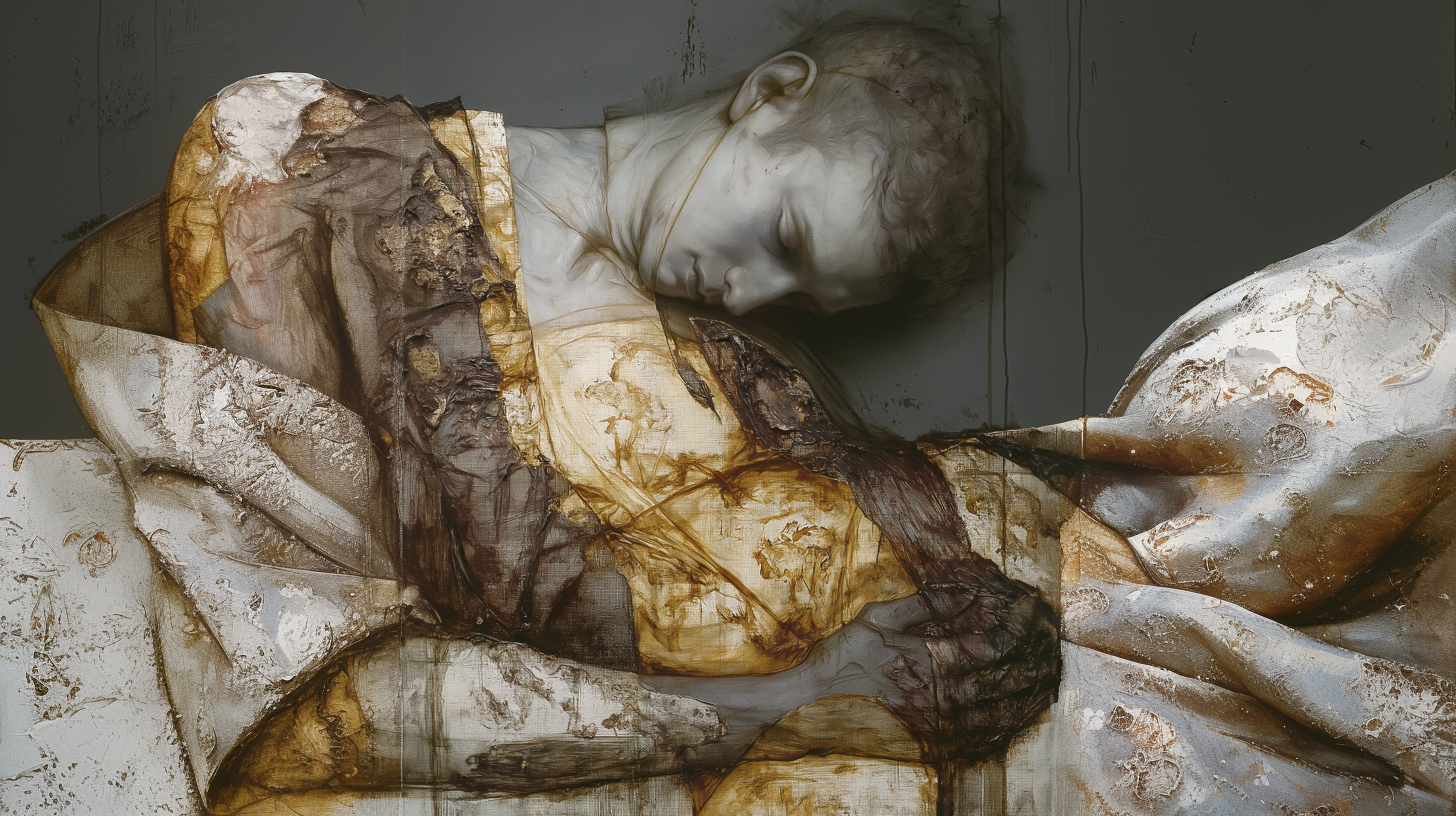
Generative models learned to represent the body from massive corpora of images.
Those images were not neutral. They carried a dated visual regime, imposed within a few decades by fashion photography, advertising, the digital turn, and the spread of retouching. A regime of the smooth, the accident-free, the corrected body.
It is this regime that the models tend to return by default whenever you prompt them with the words that trigger their most probable responses.
But these models are not reducible to what they produce on their own. They also hold other possible directions, other configurations, ones that ordinary use almost never reaches. They are not images hidden somewhere, waiting to be found. They are zones of possibility, latent, that nothing brings to the surface until a gesture comes to call them out.
My work lives in that gesture.
Entering the model
I do not search the model at random. I do not enter it with a vague formal idea of what might be interesting. I enter it with a cartography built elsewhere, before the model, in the practice of drawing and painting.
When I painted, I was not a single subject in front of a surface. I was crossed by several bodies in negotiation: the body that makes, confronted with the gesture, the weight of the hand, the resistance of the material; the body that feels, guided by intuition, emotion, immediate perception; and the body that reasons, that composes, measures, corrects, organizes according to rules.
The painting was the space where these bodies had to coexist, contradict one another, resolve, without any one of them fully prevailing.
Bodies not yet named
Behind that negotiation there was a search. In those bodies held in tension I was looking for the trace of something that was not merely their sum. A dimension that would contain them and exceed them. Bodies not yet named. A bodily truth higher than the one produced separately by gesture, by emotion, or by thought.
That search did not change its object when it changed its tool.
My old paintings and drawings now serve me as maps. They help me look, inside the model, for configurations that extend the same logic. Not bodies represented, but bodies in the act of resolving toward something that exceeds them.
I do not modify the model I use. Its landscape stays what it is. But I can force it to manifest a zone of possibility it would not show without this search.
Transmission
What I manifest alone is not enough. A form displaces nothing if it is not taken up, looked at, transmitted, corrected. Human intelligence is never strictly individual. It builds itself in layers, through reprises, through circulation.
The images I draw out of the model enter that fabric, or they do not. If they enter it, they can help displace what the next models will learn to see.
The regime of representation is not eternal. It was produced. It can be displaced.
The hidden map
And it is through a drawing that I enter the model.
The drawing is not the content of the image. It stays in the studio, like a map you do not show. It helps me search, by feel, for configurations I sense without yet knowing how to name them.
I am not sure I always reach them.
I only know that without it, I would not even know where to look.