
What Holds
What I am after is what holds when opposites coexist without resolving: what I know and what escapes me, what is mine and what is shared, the hand and the machine. I take up this tension inside generative models, working from a map my hand drew before them and outside them.
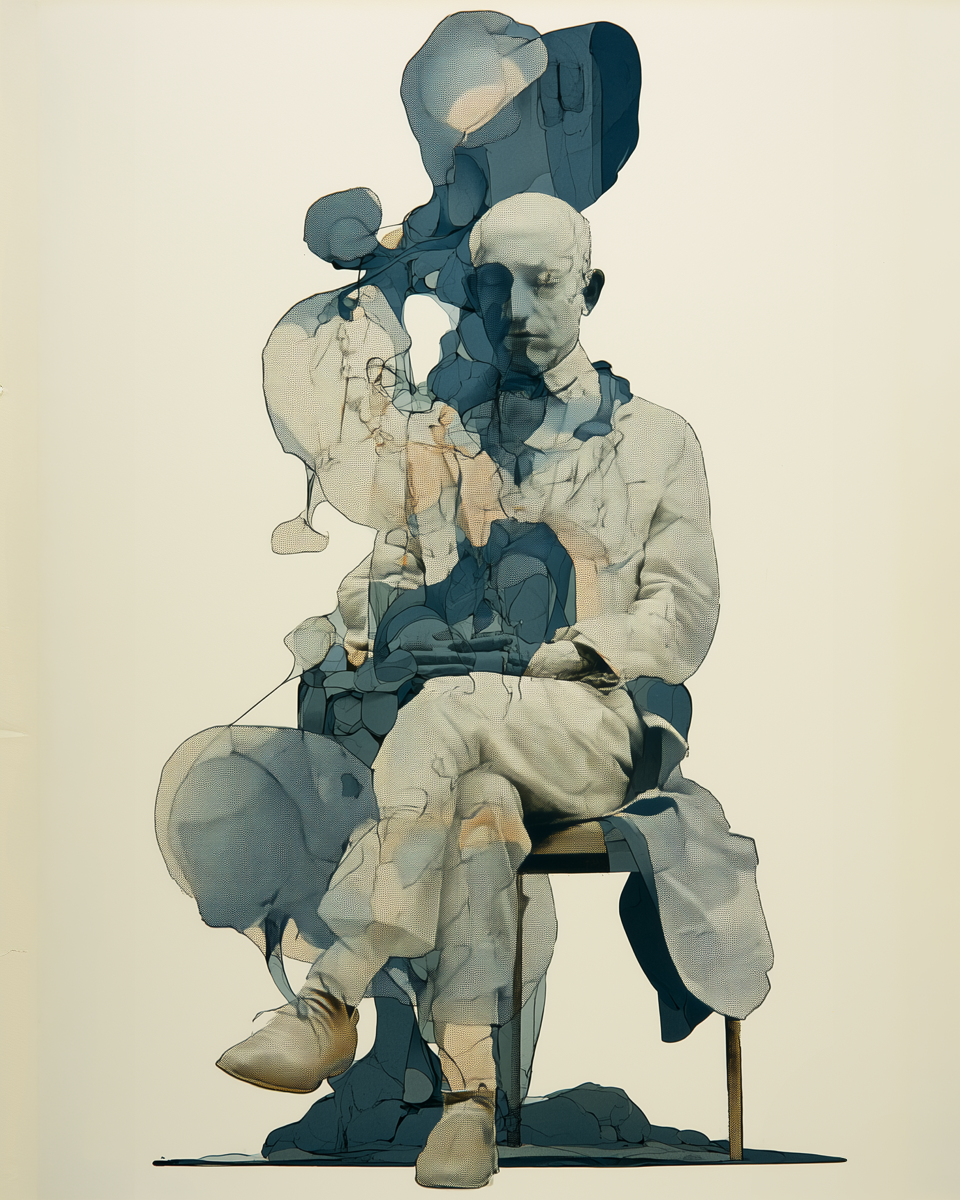
What I am after is what holds when opposites coexist without resolving: what I know and what escapes me, what is mine and what is shared, the hand and the machine. I take up this tension inside generative models, working from a map my hand drew before them and outside them.
Before every mind stands a figure that initiatory traditions call a threshold guardian. The guardian stands beyond the ego, at the threshold separating what one is from what one might become. Its function is to test what advances: it verifies one is ready to yield part of the ego to reach what lies beyond it — to leave what is relative to the self for what belongs to no one. What the self refuses to integrate is sent back, or translated at once into a language it can accept. That re-translation we call, after the fact, a projection. It is the ego's strategy to stay intact: the illusion of having crossed without ceding anything.
Cognitive science describes a kindred mechanism at another scale, which it calls predictive coding. The brain continually anticipates what it expects to see. What confirms the anticipation passes effortlessly. What contradicts it is filtered, distorted, or suspended. The names vary: confirmation bias, inattentional blindness, perceptual schemata. Where the guardian holds the ontological threshold between what one is and what one might become, predictive coding holds the perceptual threshold between what one sees and what one expected. Two distinct scales of the same conservatism: preserving the order already in place against what would displace it.
Neither threshold yields to force. The more you try to compel them, the more they stiffen. The way that remains open is narrow and operates in two moments. The foreign enters perception only by borrowing the language of the familiar — without that, it is filtered before it ever reaches the mind. Once perceived, it shifts the self only if the self consents to be shifted. No image compels.
This double crossing replays exactly on the viewer's side. The artist crosses both thresholds in producing; the viewer retraces them in looking. The crossing of one calibrates what is asked of the other: an image that has cost its author nothing demands nothing of the viewer, who reads it without friction by pure projection; an image produced beyond the artist's guardian can only be approached by a viewer who consents to an analogous displacement. For an image to do its work, a fragment of what the viewer believes he knows about himself must give, sometimes without his even noticing. The easy projection yields. The self shifts by a notch. The viewer returns slightly other.
That leaves the material. The map I hold out to the model is made of years of paintings, drawings, gestures done by hand, before the model and outside it. This map plays for the model the role of an image that fixes its starting point.
The model has its own slope. A center, familiar forms, what it returns to whenever left to itself. This slope is not arbitrary. It is the statistical residue of millions of human productions. The latent space of a generative model is thus, in its way, a partial cartography of the human mind. Fragmented, broken, but real. My map is another partial cartography, narrower and more personal, of the same territory. The work consists in making these two cartographies collide.
From this collision returns a third state. Neither the map nor the model. What appears only at their intersection. The criterion is structural and is tested by ablation. Without the map, certain regions of the latent space are never visited by the model. Without the model, certain textures are never produced by the hand. The proof that the third state exists is that one can establish it by removing either source.
Holding this collision together demands composing with three voices that do not advance at the same pace. The hand, formed in contact with matter, negotiates with the frictions of the real. Emotion works in two contrary directions, pulling toward completion and holding back before the risk of spoiling. Thought works in two registers, a first quick one that knows before it can say, a second slow one that measures and corrects. None of these three voices alone holds the truth. An image holds when these three voices agree at that instant.
The viewer, for his part, does not take part in this making. But his guard and mine yield under the same conditions. I meet this guardian each time I move toward what still escapes me. The threshold is the same on both sides. That is why this series is not a message an artist sends to an audience, but the cartography of a territory the practice explores first, and that the viewer can retrace afterward.
What remains is to name this territory. It is not the narcissistic self with its preferences and fears, exhausted in the defense of its own image. It is what analytical psychology has called the collective unconscious, what structural anthropology has named the symbolic invariants of the human mind, what Rhenish mysticism designated as the ground of the soul. The names vary. The territory is the same, that of what expresses itself through human minds without belonging to any. Artistic language has always been the privileged mode of access to this territory, because it operates precisely where discursive language stops. The image carries what discourse cannot articulate. The threshold yields to the image where it would close to the argument.
The latent space of a generative model is its statistical precipitate. Not a substitute for the territory, but an empirical trace of its topology. The word itself is not neutral. Latent means what remains hidden beneath the surface, what waits to appear. Psychoanalysis made it the latent content of the dream, distinct from its manifest content. That machine learning borrowed this term, by accident or by inheritance, says something about the depth these models touch despite themselves. The underlying wager, assumed as a wager, is that this depth is not private. What one mind opens there, another mind can retrace.
The shaping that precedes and organizes the gaze has been described elsewhere under the name manufacture of consent (see The Consensus Machine). All shaping, this work included, selects and excludes. But some shapings close a question the moment they pose it. Others try to reopen it. This second path is the one this work attempts to take, without any guarantee of arriving.
The rejection of an image may be a symptom of the guardian, or it may be the image's failure. Three tests serve to discriminate: the work holds without commentary; it holds formally without the crutch of the practice that produced it; it survives an informed critique that owes it nothing. If any of these tests fails, the fault lies with the image, not with the guardian.
The stake is not to impose an answer. It is to extend, modestly, the field of the possible. To map out zones that would otherwise remain inaccessible, and to make them passable for whoever will venture there.
Like a broken mirror of the human mind, to be reassembled in order to find the reflection of our common mind.
References
- Carl Gustav Jung, Aion: Researches into the Phenomenology of the Self (1951) — collective unconscious and the projection of the shadow as a mechanism isomorphic to the guardian.
- Claude Lévi-Strauss, Structural Anthropology (1958) — symbolic invariants of the human mind, deep structures shared across societies.
- Meister Eckhart, Sermons and Treatises (13th-14th century) — Seelengrund, the ground of the soul in Rhenish mysticism. The concept's philosophical posterity runs through Heidegger's thinking of the Grund.
- Sigmund Freud, The Interpretation of Dreams (1900) — the distinction between latent and manifest content of the dream, which gives the word "latent" its psychoanalytic charge.
- Edward Bulwer-Lytton, Zanoni (1842) — the first modern literary crystallization of the Dweller of the Threshold (threshold guardian), to be distinguished from the doctrinal use later made of it by Theosophy, Steiner, and the transpersonal lineage. The figure itself is older and recurrent: gatekeepers of the Egyptian Book of the Dead, the judge-demon of the Chinvat bridge in Zoroastrianism, the seven valleys of Attar (The Conference of the Birds, 12th century), the guardians of the bardo in the Tibetan Bardo Thödol.
- Karl Friston, Andy Clark, Anil Seth — predictive coding (predictive processing), the most precise contemporary framework for the equivalent cognitive mechanism.
- Daniel Kahneman, Thinking, Fast and Slow (2011) — System 1 / System 2 distinction, with Gary Klein's correction on expert intuition.
- Daniel Simons and Christopher Chabris, The Invisible Gorilla (2010) — inattentional blindness, the experimental manifestation of filtering by expectation.
- Walter Lippmann, Public Opinion (1922) — "manufacture of consent", taken up here by way of The Consensus Machine and treated as a counter-proof.
- Internal link with Topography (May 2026) and The Consensus Machine (June 2026).